The Stoics
Zeno of Citium
Founder of Stoicism
c. 334–262 BC
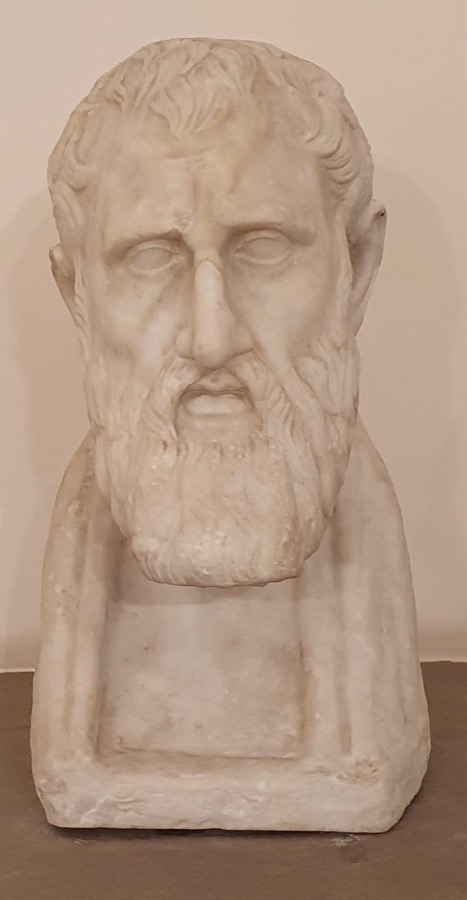
Roman bust, Farnese collection, Naples. Identification is traditional rather than certain.
Zeno came to Athens from Citium in Cyprus, a merchant of Phoenician descent, and lost his cargo at sea. The story he told afterwards was that the shipwreck was the making of him. Adrift in a strange city, he wandered into a bookseller's, read an account of Socrates, and asked where such men were to be found. The bookseller pointed at Crates the Cynic walking past.
He taught in the Stoa Poikile, the painted porch on the edge of the Athenian agora, and the school took its name from the building rather than the man. Everything he wrote is lost, including a Republic that scandalized later Stoics. What survives is the shape of the thing: that virtue alone is good, that externals are indifferent, and that a life goes well when it is lived in agreement with nature.
What he taught
Virtue is the only good. Everything else, health, wealth, reputation, is material the good life is built from, not the thing itself.
Works
- Republic (lost)
- On Human Nature (lost)
Who it is for
Anyone who wants to know where the whole thing started, and on what.
Where to start reading
 Stoicism (Ancient Philosophies)
Stoicism (Ancient Philosophies)
The serious scholarly introduction. Sellars is a philosopher specializing in the ancient Stoics. This is the book to read after the practical introductions if you want to understand the school's full architecture (logic, physics, ethics) and its place in ancient thought. Concise, dense, definitive.
 Philosophy as a Way of Life
Philosophy as a Way of Life
The book that recovered ancient philosophy as practice rather than theory. Hadot, French scholar, a generation's worth of work, argues that for the Stoics and their contemporaries, philosophy was a daily discipline of attention and exercise, not a body of doctrine. Foundational for understanding why Marcus is structured the way it is.
Some links above are affiliate links. How this works →

Marcus turns these voices into a daily practice: a morning compass, a daily reading, and a structured evening reckoning, for iOS.
Explore the app →