The Stoics
Epictetus
Stoic teacher
c. 50–135 AD
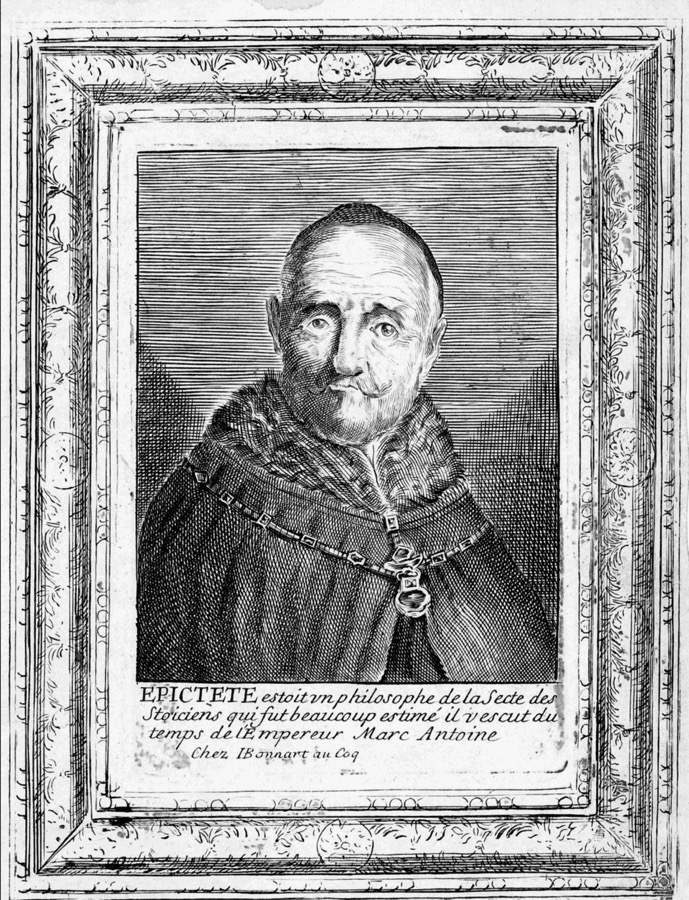
No authentic likeness survives. This is an engraving by Henri Bonnart, c. 1700, invented more than fifteen centuries after his death.
Epictetus was born into slavery in Phrygia and owned in Rome by a secretary of Nero's. He was permitted to study under Musonius Rufus while still enslaved. He was lame, by one ancient account because his leg was broken by his owner, and he mentioned it only as an example of something outside his control.
Freed, he taught in Rome until Domitian expelled the philosophers, then founded a school at Nicopolis in western Greece. He wrote nothing at all. Everything we have was recorded by a student, Arrian, who insisted he had taken it down verbatim, and it reads like it: interruptions, sarcasm, and the sound of a man refusing to let a room off the hook.
What he taught
Some things are up to you and some are not. Nearly every disturbance you feel comes from confusing the two.
Works
- Discourses (recorded by Arrian)
- Enchiridion
Who it is for
Anyone who wants to be told the truth rather than comforted.
Where to start reading
 Discourses, Fragments, Handbook
Discourses, Fragments, Handbook
Epictetus was born a slave and became the most influential Stoic teacher of the Roman empire. The Discourses are his classroom, the Handbook his concentrated practice manual. Where Marcus is private and tonal, Epictetus is direct and instructional. Start with the Handbook if you want the practice in its tightest form.
 The Art of Living
The Art of Living
An interpretive rendering of Epictetus's Handbook, not a translation, and the book's own subtitle says so. Lebell rewrites for clarity rather than scholarship, controversial among purists, but for a first encounter with Epictetus it's the most accessible door. Read this, then go to Hard.
Some links above are affiliate links. How this works →

Marcus turns these voices into a daily practice: a morning compass, a daily reading, and a structured evening reckoning, for iOS.
Explore the app →