The View From Above
 By
By 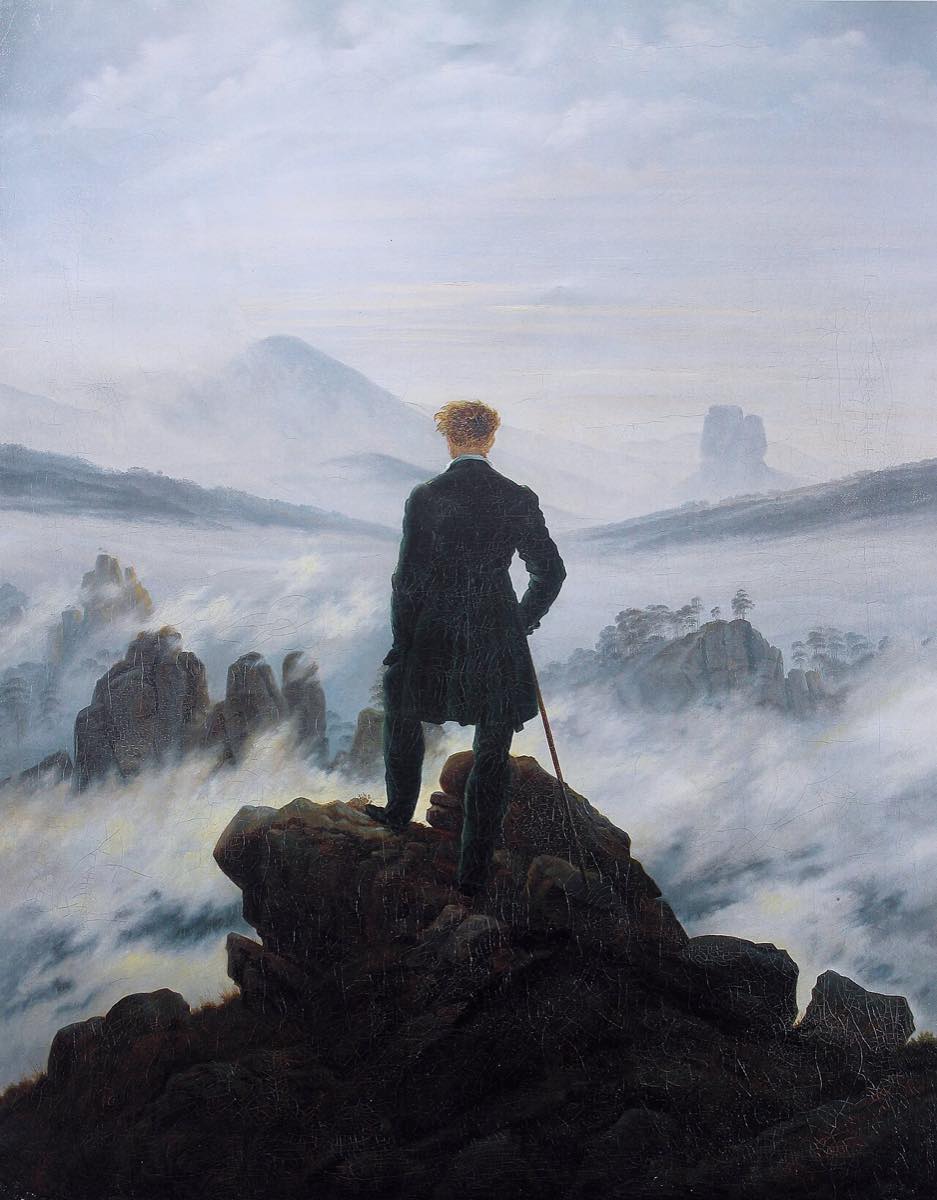
Marcus keeps going up.
Throughout the Meditations he pulls the camera back: to the whole earth, to the span of recorded time, to the courts of emperors long dead and now entirely forgotten. He looks down at the crowds, the markets, the marriages and lawsuits and funerals, and notes how much of it is repetition. Then he asks what, from there, is actually the matter.
The scholar Pierre Hadot named this the view from above and identified it as a distinct spiritual exercise rather than a mood. It is probably the most immediately usable thing in Stoicism, and the easiest to do badly.
What Marcus actually does
The clearest instance is in Book IX, where he suggests observing the movements of the stars as though you were running alongside them, and considering constantly how the elements change into one another. Elsewhere he surveys human life from a height and sees herds, armies, farms, weddings, dissolutions, courts, deserts, foreign nations, festivals, mournings, markets, all mixed together and made orderly by contraries.
And in Book IV, the passage that does most of the work:
Asia and Europe are corners of the world. The whole sea is a drop. Athos a clod. All the present time is a point in eternity.
He is not saying nothing matters. He returns from these passages to specific duties, immediately and every time. He is resizing, not dismissing.
Seneca does the same in Natural Questions, where he describes the soul rising to survey the whole and says that from up there the things people fight over look extremely small, and that this is the beginning of wisdom rather than the end of caring.
What it is for
Three things, and they are distinct.
Scale. Most distress involves a silent claim about size: this is enormous, this is the whole of my life. Altitude tests that claim directly. Some things survive it and turn out to be genuinely large. Most do not.
Sympatheia. From above you cannot see only yourself. You see everyone else doing the same things, with the same fears, most of them not thinking about you at all. The Stoic term is sympatheia, the interconnection of all things, and it is why this exercise is supposed to produce more fellow-feeling rather than less. Marcus’s version always ends in the crowd, not above it.
Transience. From a height you see time as well as space: the empires that rose and fell, the names now archaic, the fact that everyone doing this before you is gone. The intended effect is urgency, not despair. Nothing lasts, so do the thing.
The failure mode
Done wrong, the view from above produces nihilism. Nothing matters, we are specks, why bother.
That reading is available and the Stoics did not take it. The difference is what you do at the top of the ascent.
If you stay up there, everything flattens, including the obligations that make a life. If you go up, resize, and come back down, you return holding the same duties with a more accurate sense of their weight. Marcus always comes back down. Every one of these passages is followed within a few lines by something concrete: be just, do the work in front of you, do not be irritated with the man who smells bad.
The exercise is a corrective lens, not a destination. If it leaves you feeling that nothing is worth doing, you stopped halfway.
How to run it
Five minutes, best done seated with the eyes closed, and best when something has taken on a size you suspect it does not have.
- Start where you are. The room, the building, the street.
- Rise slowly. The neighborhood, the city, the region, the coastline. Keep going until the whole earth is in view and the weather is moving over it.
- Add the others. Everyone below is occupied with something that feels to them exactly as urgent as yours feels to you. Nearly all of them will never know you exist, and that is not an insult.
- Add time. The same view a hundred years ago, and a hundred years from now. The people in both are gone or not yet arrived. Everyone who worried about what you are worrying about is finished worrying.
- Come back down. This step is not optional. Return to the room, the day, and the specific thing. Ask: at its actual size, what does this ask of me?
The last question is the exercise. Everything before it is preparation.
When to use it
It works on things that have swollen: an argument replaying at 2am, a professional setback that has taken over a week, a fear about how something will look to people whose opinion you have not examined.
It works poorly on grief. Scale is the wrong instrument for loss, and applying it there tends to feel like being told your loss is small, which is not what the exercise says and not a useful thing to hear. The Stoic material on grief is different, and gentler, and mostly in Seneca’s consolations.
Further reading
Marcus, Meditations Books IV and IX, and Seneca’s Natural Questions, Book I preface. Pierre Hadot’s Philosophy as a Way of Life is the modern book that identified this as a formal exercise, and it is on our Library.
For the daily practice this sits inside, see how to keep a Stoic journal. The related exercise for what has not happened yet is premeditatio malorum.

Marcus turns this into a daily practice for iOS: a morning preparation, a daily reading, and a structured evening examination.
Explore the app →